
Why So Many Family Scapegoat Survivors Lose Hope in Healing the Inner Bully
Many family scapegoat survivors give up on healing their Inner Bully due to loss of hope at so many failed attempts. It’s completely understandable.
They try to heal their Inner Bully (the cruel inner voice who repeats the phrases of childhood abuse) from many different angles. There is so much frustration with it.
They know they have an Inner Bully - that’s not the issue. Although even then, it’s so baked into who they are that it can register as a type of ‘this is just who I am’ and a type of hopelessness, like ‘how am I ever going to heal this?’
Their hope has been damaged so much by tried and failed attempts.
If you wanted to play the piano and had difficulty coordinating your left hand with your right hand and you went to 15 different piano teachers over a span of 25 years it would be reasonable to conclude that ‘maybe piano is not for me’.
And that’s fine for musical instruments.
But when the challenge is something that lives inside you and impacts every waking moment of your life - just letting it be, is not an option that is going to bring relief. You’ll continue to live with the pain.
When a new healing opportunity presents itself - there comes a point when the fear of experiencing another disappointment outweighs the hope that this time it might work. That’s perfectly human and reasonable.
Family scapegoat survivors are exhausted.
They’ve often been left trying to piece healing together on their own.
And thus, they’re not aware that healing the inner bully requires structure, sequencing, repetition, and integration.
The modalities that they’ve tried, generally don’t account for this, so they miss out on understanding the full extent of their trauma and the full arc of recovery.
The approaches they’ve explored can often unknowingly under estimate and minimise the roots of the cruel inner voice.
As a result, survivors can be left believing that they’ve “failed” healing, when in reality they were attempting to resolve something profoundly layered with tools or expectations that didn’t fully account for the depth of the wound.
Continuing to live with a stubborn cruel inner voice is not their fault.
There actually is a way to heal this.
Both in my own healing journey and in working with clients since 2020, I began to notice clear patterns in what actually helped people create lasting change.
Over time, this evolved into a three-phase roadmap for healing the inner bully.
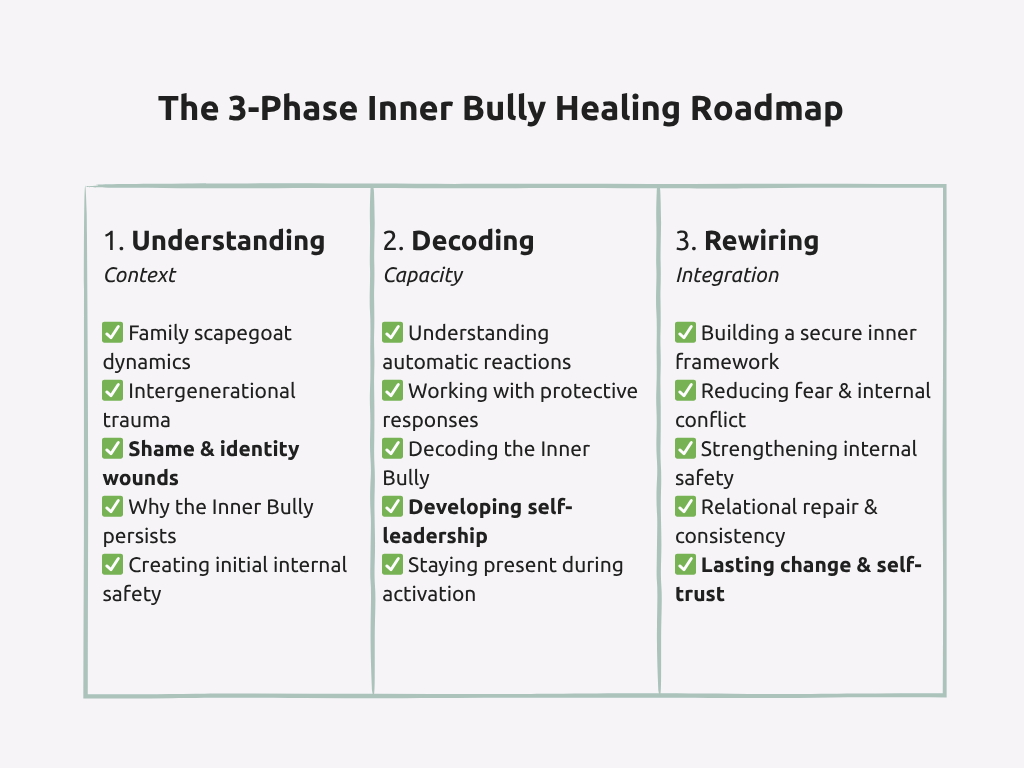
Phase one is Understanding - understanding how the Inner Bully was formed, the role of shame in toxic family systems, and how those experiences shaped identity. Without this foundation, people often try to heal the symptoms without fully understanding the root of what they’re dealing with.
Phase two is Decoding - this is where most other approaches start and it’s often premature. Phase two is about learning to work with your own internal parts, understanding protective responses and skillfully managing inner bully activation.
Phase three is Integration - developing self leadership, self compassion, internal safety, and the capacity to create lasting change without constantly falling back into shame and self attack.
Some people might secretly believe - ‘if I still struggle with this voice after so many years, there must be something wrong with me’ when in actual fact it was that they kept trying things that simply never addressed the root structure.
***
About the Author
Mary Toolan is the founder of Scapegoat Child Recovery Ltd.
She works with high-functioning adults who were cast as the family scapegoat and are now navigating life after No Contact, or actively working towards it.
Her work helps people untangle the attachment trauma and identity conditioning shaped by family scapegoating, so they can build a calmer, more self-directed life.
